What is a polyrhythm? A clear explanation with examples
By Asztalos Levente Updated 4 min read
A polyrhythm is two or more evenly spaced pulses played at the same time, each dividing the same span of time into a different number of parts. In 3 against 2, one part plays three even notes while the other plays two, and both meet again at the start of every cycle.
A polyrhythm is what you get when two parts keep perfectly even time but disagree about how many notes fit into the same span. One hand plays three evenly spaced notes, the other plays two, and both start together. Neither part is syncopated on its own; the tension comes from hearing them at once.
The two numbers in a ratio
Polyrhythms are written as a ratio such as 3:2, read “three against two” or “three over two”. The second number is usually the main pulse, the one you would tap your foot to. The first number is the layer laid over it.
Not everyone writes them in that order, so it is worth remembering what actually defines a polyrhythm:
- there are two layers, and each one is evenly spaced
- both layers start at the same moment
- both layers fill exactly the same span of time, then repeat
How the two layers line up
The easiest way to see a polyrhythm is to split the cycle into a grid both layers fit on. For 3:2 that grid has six counts, because 6 is the smallest number that both 3 and 2 divide into.
| Count | 1 | 2 | 3 | 4 | 5 | 6 |
|---|---|---|---|---|---|---|
| The three | ● | ● | ● | |||
| The two | ● | ● |
Played together, the layers sound on counts 1, 3, 4 and 5. That combined pattern is called the composite rhythm, and learning to hear it as a single rhythm is usually the way in. The same method works for any ratio: 4:3 fits on a grid of 12, 5:4 on a grid of 20.
Polyrhythm, polymeter and cross-rhythm
These three terms get mixed up, but they describe different things.
- Polyrhythm: both layers fill the same span of time with a different number of evenly spaced notes. The notes of one layer are longer than the notes of the other.
- Polymeter: both layers use the same note length but different bar lengths, for example a 3-beat pattern against a 4-beat pattern. They drift apart and only line up again after 12 beats.
- Cross-rhythm: a polyrhythm that runs against the prevailing meter for a long stretch. The term comes up most often in discussions of West African and Afro-Cuban music, where the pull between three and two runs through much of the rhythm.
Common polyrhythms
- 3:2 is the most common by far. Composers have long used its bar-level form, the hemiola, where two bars of three are phrased as three groups of two.
- 4:3 and 3:4 are the next step. The right hand of Chopin’s Fantaisie-Impromptu famously plays four notes against the left hand’s three.
- 5:4, 5:3 and 7:4 appear in jazz, fusion and progressive music, and as solo exercises for drummers and pianists.
How to practice a polyrhythm
- Say it first. Speak the composite rhythm with a phrase that fits it. For 3:2 many players use “nice cup of tea”.
- Tap it slowly. One layer on each knee, counting the full grid out loud. Speed comes later.
- Switch the beat. Feel the two as the pulse, then the three. The rhythm does not change, but the way you hear it does.
- Play along with both layers, then drop one. A metronome that can play both layers with different sounds lets you check yourself. Mute one layer and keep it going in your head.
- Raise the tempo only when it is relaxed. If one hand starts following the other, slow down again.
Practicing polyrhythms in MetronomeLab
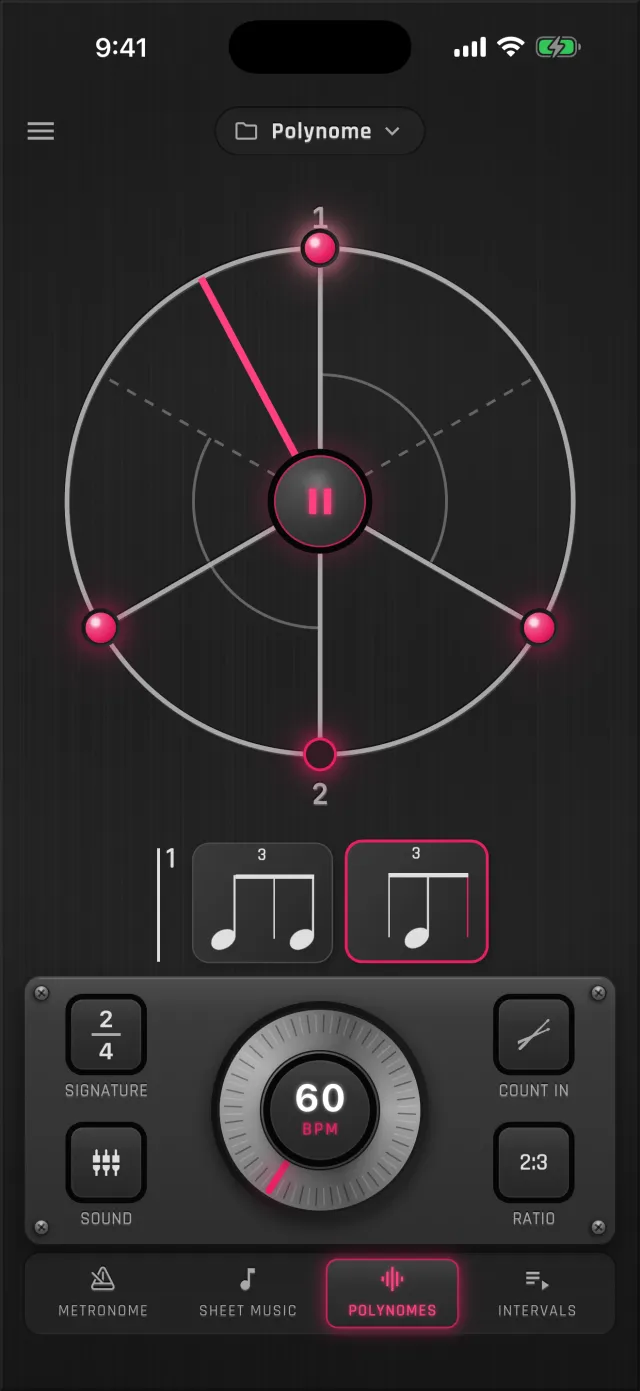
The polyrhythm trainer on this site plays any ratio from 2 to 11 on each side, right in your browser. The MetronomeLab app goes further: its Polynomes tab draws both layers on a rotating circle so you can see where they line up before you hear it, lets you give each pulse its own sound, and saves your ratios as presets. One thing to know: the app’s Ratio control lists the beats first, so 3 against 2 is set as 2:3. Polyrhythms up to 5:5 are free, and Pro unlocks everything up to 11:11.
When the basics feel comfortable, move on to 3 against 2, then 3 against 4 and 5 against 4.
Try it: 3:2
BPM is the speed of the 2-beat layer, the pulse you would tap your foot to.
Frequently asked questions
Is 3:2 the same as 2:3?
They produce the same combined rhythm. The difference is which layer you feel as the beat: in 3:2 the two is usually the pulse you tap your foot to and the three is laid over it, in 2:3 it is the other way round. Practicing both ways is one of the best polyrhythm exercises there is.
What is the hardest polyrhythm?
There is no single answer, but ratios made of larger numbers that share no common factor, such as 7:5 or 11:10, are harder because the two layers almost never line up. A ratio like 6:4 is easier than it looks: it is 3:2 played twice.
Do I need to read music to learn polyrhythms?
No. Counting a shared grid, speaking a phrase that matches the rhythm and tapping it on your knees are enough to learn the common ratios. Notation helps later, when you want to play them in written music.

