What is a visual metronome, and who is it for?
By Asztalos Levente Updated 3 min read
A visual metronome shows the beat instead of, or as well as, sounding it: with a swinging arm, a flashing light or an animation on screen. Because you can see the next beat coming, it helps you anticipate time, practice where a click is hard to hear, and understand subdivisions and polyrhythms.
A metronome tells you where the beat is. A visual metronome also shows you, so you can follow time with your eyes as well as your ears.
How it differs from a click
An audible click tells you that a beat has just happened. If you are early or late, you only find out afterwards. A good visual metronome shows the beat coming: a moving arm or a rotating hand gets closer and closer to the next beat, so you can prepare for it the way you would watch a conductor’s baton.
That is also why the old mechanical pendulum metronome was more useful than it looked. You could see the arm approach each beat, not just hear the tick.
Who benefits most
- Drummers and bands in loud rooms, where a click is easy to lose under the volume.
- Deaf and hard-of-hearing musicians, especially with vibration as well.
- Teachers and classrooms: the whole group can follow one screen.
- Anyone learning subdivisions or polyrhythms. Seeing where an off-beat or a second layer falls is often easier than hearing it at first.
- Silent practice on a practice pad or a silent piano, late at night or in shared spaces.
What to look for
- It shows the next beat, not just the current one. A light that flashes on the beat is better than nothing, but it gives you nothing to anticipate.
- Accents, rests and subdivisions are visible. You should be able to see beat one, quiet beats and the notes in between.
- Picture and sound stay in sync. Any delay between the two makes the tool worse than either one alone.
- It is readable from a distance, on a music stand or across a room.
- It works with the sound off, and ideally with vibration.
How MetronomeLab shows rhythm
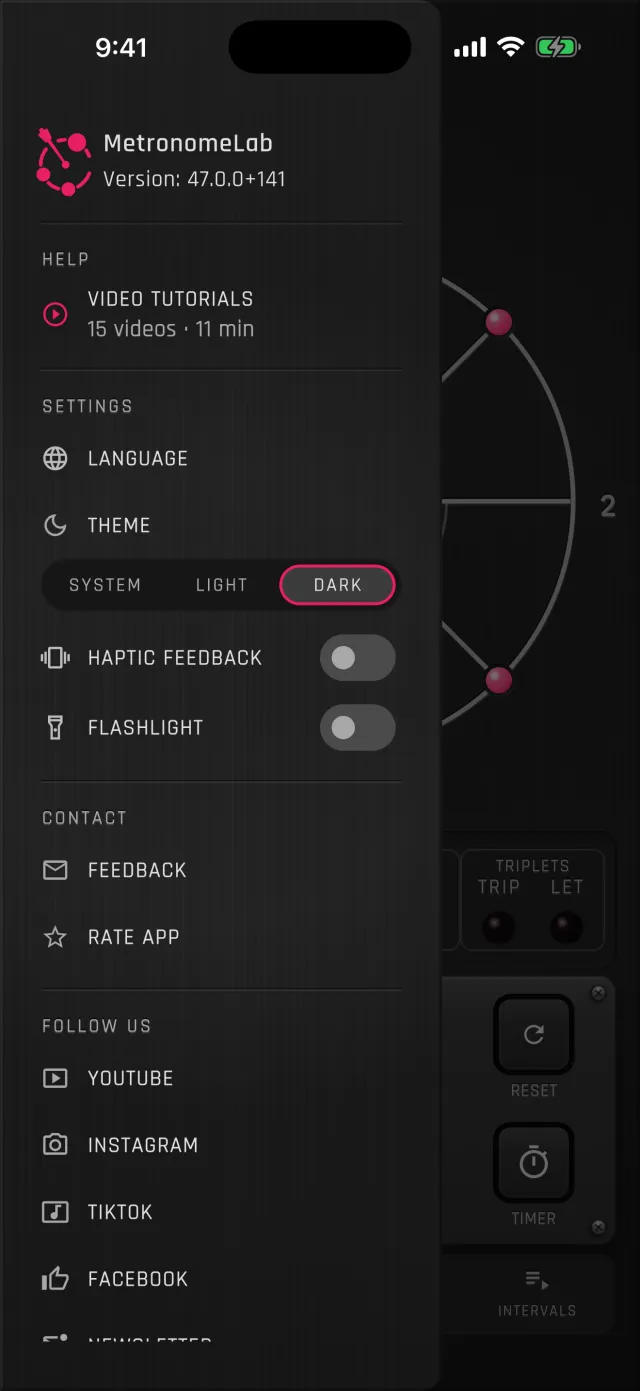
MetronomeLab draws the beat on a rotating circle. A hand sweeps around it and every beat and subdivision that sounds is a point on the ring, so you see where the next note falls before you hear it; a muted beat stays as an empty spoke. Polyrhythms appear as two sets of points on the same circle, which makes it easy to see where the layers meet. You can also feel the beat through haptics and the phone’s flashlight, switched on in the menu, and it keeps playing in the background.
You can try the idea right now with the polyrhythm trainer, or read about practicing with a metronome.
Frequently asked questions
Can a visual metronome replace an audible click?
For many situations, yes: silent practice, loud rooms and teaching. Most players still use sound as well, because the ear reacts to timing faster than the eye. A good visual metronome lets you use either, or both.
Is a visual metronome useful for deaf or hard-of-hearing musicians?
It can be. Many deaf and hard-of-hearing musicians rely on visual and physical cues, and a visual metronome combined with vibration gives the beat without needing to hear a click.
Is a pendulum metronome a visual metronome?
In a way, yes. The swinging arm of a mechanical metronome was the original visual metronome: you can see it approach each beat. Screen-based visual metronomes keep that advantage and add accents, subdivisions and polyrhythms.

